
New revenue streams
from 5G.
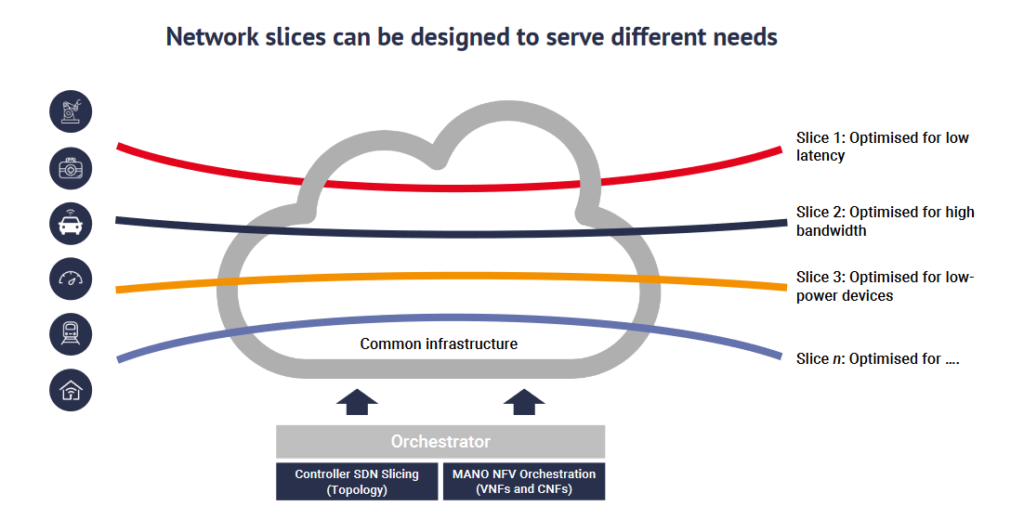
Network slicing is one of the most highly anticipated capabilities and potentially an integral enabler for monetizing 5G. Slicing promises to enable more tailored flexible connectivity services, designed to meet end customers’ specific requirements — such as ultra low latency, high reliability mission-critical services in Industry 4.0, or high bandwidth infotainment services.
Network slicing provides a huge business potential for CSPs, opening up many different opportunities across a wide range of use cases and industry segments: virtual and augmented realities, remote healthcare, autonomous vehicles and smart cities, to name just a few.
The current CSP business will have a 0.75% CAGR, compared to 12% for digital industrial. According to the latest Ericsson report, a $200 billion opportunity for CSP network slicing can be derived from the total global digitalization revenues.
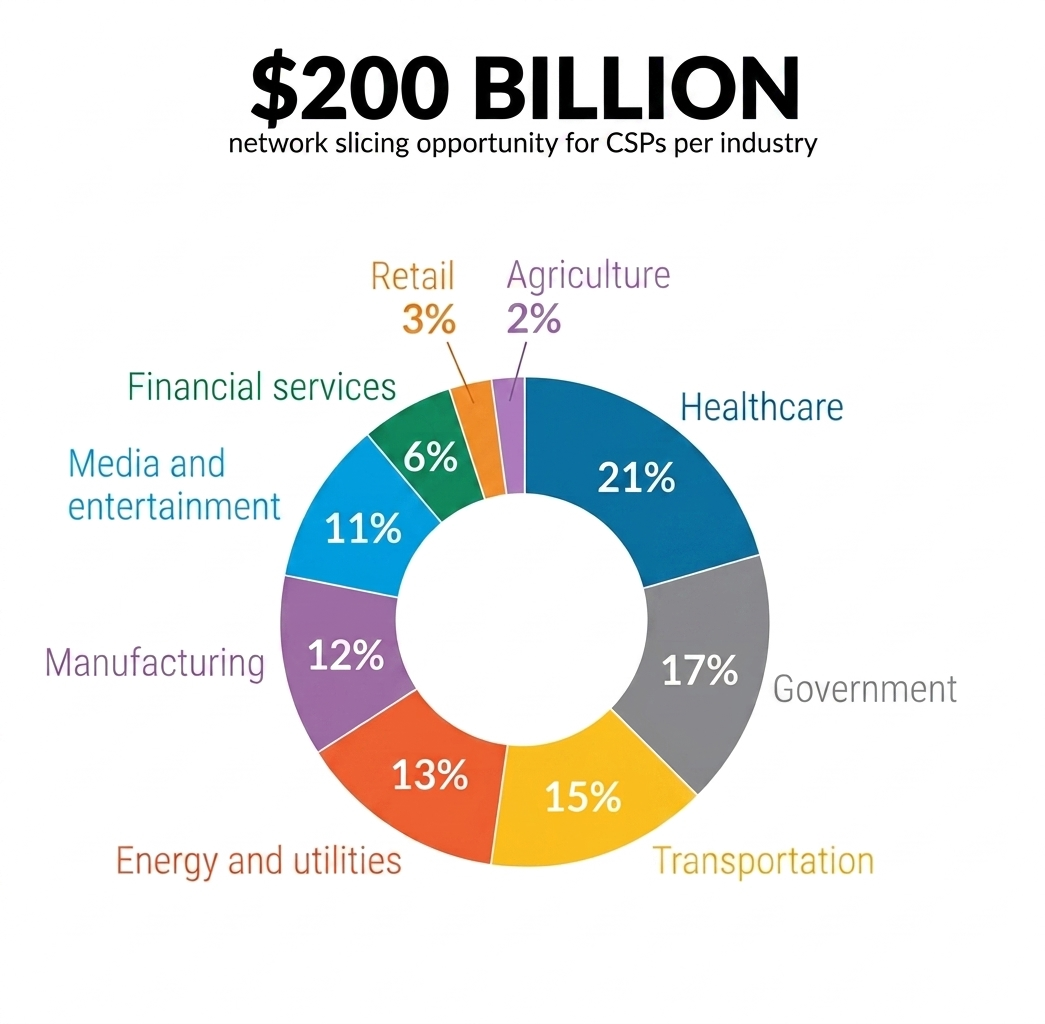
Let’s talk about getting new revenue streams by adding completely new services. Take healthcare as an example — the largest piece of the pie.
CSPs can use network slicing to provide isolated, low-latency and high-throughput connectivity for video streaming and assessment of patient conditions in an emergency vehicle. In addition, the CSP could also partner with software and hardware developers to sell a complete solution.
Slicing can generate revenue by enabling premium pricing and new business models. Demanding use cases can require custom-made services which result in higher fees.
For example, a network slice to a transportation company that provides more bandwidth and network isolation to enable high-quality and secure monitoring for transport of high-value goods that require a strict cold chain.
Network slicing opens up new business models as the network becomes a platform for other businesses. This will result in new partnerships and go-to-market models. CSPs will play a different role in relation to the end-customer depending on the domain:
The CSP offers fixed wireless access (FWA) based on a dedicated network slice.