Telecom operators leverage vast amounts of customer, network, and service data to optimize operations, personalize customer experiences, and unlock new revenue streams.

According to industry reports, the global data revenue for telecoms is expected to surpass $700 billion by 2025, driven by increasing demand for data-intensive services such as 5G, IoT, and cloud applications. Additionally, companies that harness advanced data analytics report a 20-30% improvement in customer satisfaction and a 15-20% increase in revenue through targeted marketing, churn reduction, and service innovation.

Furthermore, a McKinsey & Company study indicates that more than 70% of telecom executives see data-driven decision-making as critical to their future success. As the industry evolves towards autonomous networks and personalized services, investment in robust data management and analytics capabilities becomes an imperative.

A Current State of the Data: fragmentation creates a gap

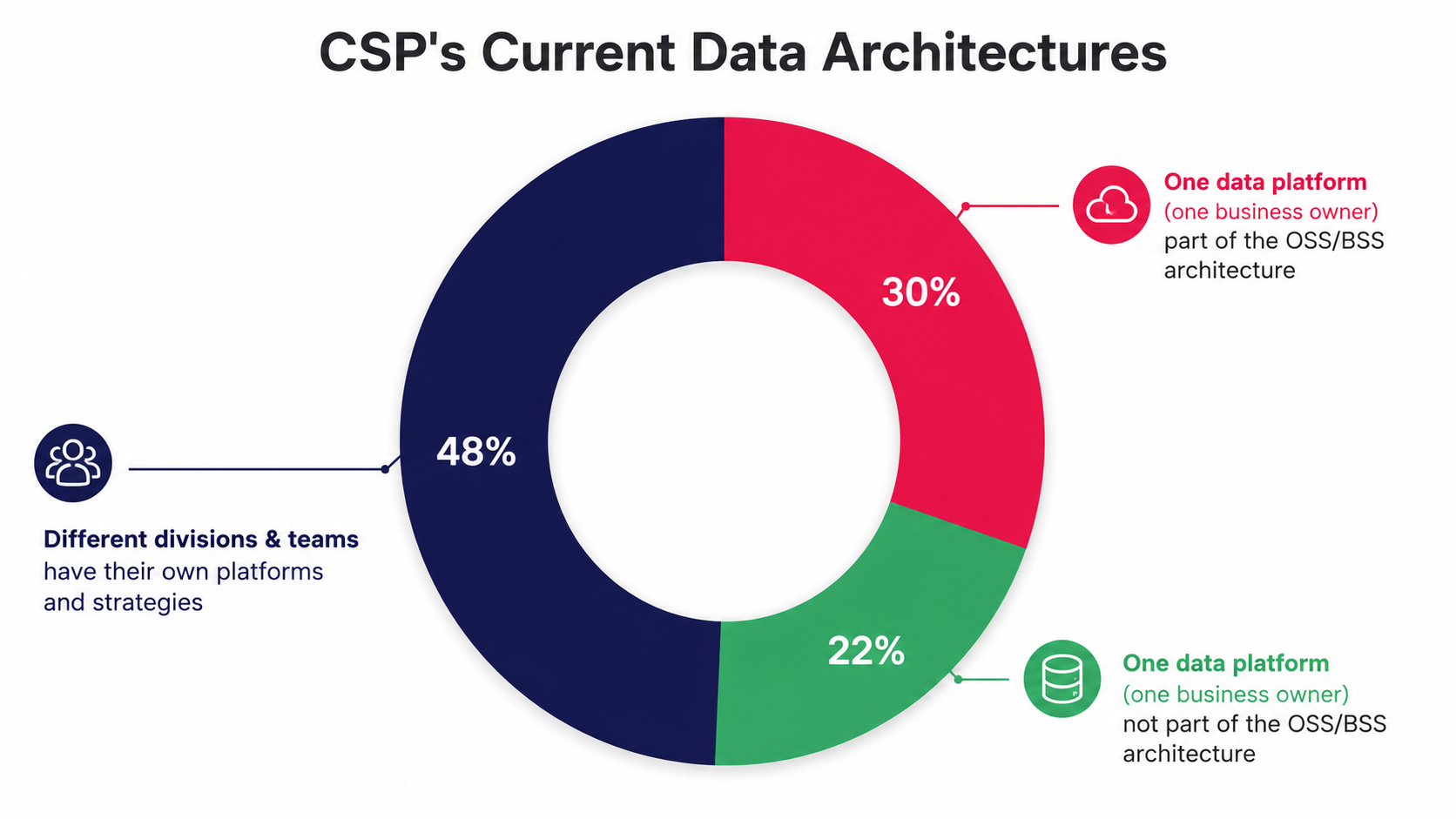
I was recently readingt through the latest TM Forum report on unlocking AI potential through modern data architecture and encountered a key chart illustrating the current landscape within CSP – see below:

Article content

The analysis of the current data architectures within CSPs reveals a significant level of fragmentation across organizations. Nearly half (48%) of CSPs operate with different divisions and teams maintaining their own platforms and strategies, indicating a decentralized approach.

  • Only 30% of CSPs have a unified data platform that is part of the OSS/BSS architecture.
  • Almost 50% of CSPs have disparate data strategies across different divisions and teams.
  • Almost 1/4 have a data platform not integrated with core operations.

Overall, these findings highlight the industry’s varied maturity levels and the potential need for standardization to unlock more scalable and efficient AI use cases.

From Fragmented Data to AI Leadership

By addressing the fragmented data architectures and developing a more integrated approach, CSPs can lay the foundation for effective AI implementations. This strategic alignment enables CSPs to utilize the full potential of AI, driving innovation, customer satisfaction, and competitive advantage.

CIOs who develop a competitive advantage through AI focus on the underlying IT infrastructure, and the right data foundations allow the business to shift rapidly as new opportunities emerge.

Soure: CIO Onlinelink.

By focusing on these strategic areas, CIOs can accelerate their organizations’ digital maturity, unlock AI potential. Our Readiness IT – a CONKORD company expert team comprises a dedicated group of seasoned technology advisors, solution architects, subject matter experts, and business analysts. We support CIOs in defining and executing actionable roadmaps to:

1. Build a Data Strategy

With nearly half of CSPs operating with fragmented, division-specific platforms, there is an urgent need for standardization to improve data consistency, quality, and accessibility. CIOs should prioritize developing a cohesive data strategy that aligns across units to support scalable AI and analytics initiatives.

2. Establish a Unified Data Platform

CIOs should evaluate the maturity of their existing architectures and consider investment in comprehensive data platforms that facilitate seamless data flow, reduce silos, and accelerate digital transformation. Develop a centralized data platform that integrates seamlessly with existing OSS/BSS systems. This ensures consistent data flows and easy access for AI-driven processes, enabling end-to-end automation and analytics.

3. Create Data Governance and Architecture Design

Establishing clear data governance frameworks and architecture standards will be crucial for managing diverse data sources and ensuring compliance, security, and quality, thus enabling AI initiatives to scale effectively.

4. Modernize Legacy and Isolated Platforms

The 23% still maintaining isolated data platforms represent a barrier to AI-driven innovation. CIOs must plan for phased migration, modernization, or integration strategies that mitigate risks and ensure data readiness for advanced analytics and AI use cases.

5. Align Teams and Divisions

Implement governance frameworks to align data strategies across divisions. Encourage collaboration through cross-functional teams that focus on unified goals and shared data insights, effectively breaking down silos.

We are a trusted high-tech partner with over 20+ years of experience in the telco industry. With deep industry expertise, technical excellence, and AI-driven innovation, we empower CSPs on their digital transformation journeys — from modernizing B/OSS to achieving autonomous operations. We bridge legacy O/BSS systems with cloud-native, data-driven architectures while ensuring business continuity and rapid ROI.

As an Agentic Integration Company, we don’t just connect systems. We architect adaptive, intelligent digital ecosystems aligned to industry best-practices (TM Forum) – so you can innovate, scale, and lead.

Article content